
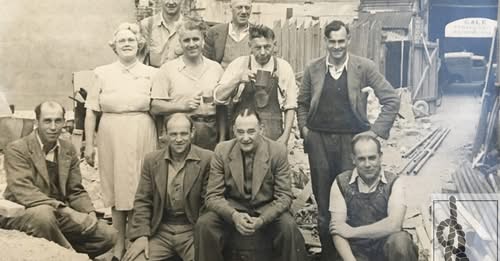
Peter Garland who has sent some more fascinating research of his own. We are sharing this in full along with a photo donated to the Local History Centre fairly recently.
Air Raids on Bridport in 1942
“Although not a planned target in itself, Bridport was on the direct flight path to the aircraft factories in Yeovil and Bristol. Subsequently, the countryside around West Dorset received a number of bombs from bombers that released their bomb loads arbitrarily, when damaged or being harassed by the RAF. These incidents were recorded by the authorities at the time and are available for research purposes.
According to written historical accounts and confirmed by the verbal recollections my family, there were two air raids that actually targeted Bridport in World War 2 and that ended up tragically with civilian casualties. The second bombing, in late 1942 may well have been an example of a bomber crew having been given an inland target, losing nerve and deciding to drop their bomb load on a coastal town, in this case Bridport. According to my family accounts and Bridport historical records, a Dornier flew from West to East along the main street dropping a stick of four bombs, with the first one lodging in the entrance to the Westminster Bank, but did not explode. The Dornier’s flight path meant the second bomb hit houses in East Street, creating a bomb site that is now East Street Car Park and the third bomb fell near Melville Square creating a bomb site we kids used to play on in the late 1950s. The final bomb fell into the river in East Road. My Mother’s home in Seymour Place must have been straddled by bombs two and three.
The first bombing, the subject of the recent Bridport Town Council Facebook posting, appears in many ways very different, except that both resulted in the tragic of loss of life. As many historical reports have recorded, on August Bank Holiday (August 2, 1942) two fighter bombers flew in low over West Bay in broad daylight and specifically targeted an area that included the Star Inn pub in West Street. Some reports had these planes as ME 190s, but I think it likely that, rather than being ME bf109s, they might have been Focke-Wulf FW 190s. These were higher performing than the ME bf109s in that they could carry twice the bomb load and were subsequently used for precision ground attack missions.
The apparent deliberate targeting of an area of Bridport in this attack leads to real questions surrounding the purpose of this raid. The commitment of two high performance ground attack aircraft, in broad daylight, flying at the extreme of their range at low level, suggests a planned raid on a significant target. The Star Inn would not, I suggest, have been that target, although clearly it was close enough to be collateral damage. Many pictures taken at the time show major bomb damage at the rear of the pub. These various historical facts may enhance the credibility of the family memory passed on to me by a cousin who was a teenage Post Office messenger boy in Bridport during the war. According to his account, the actual target was a building at the rear of the pub that was the site of a funeral monument stonemason business. He indicated that this stonemason had a contract from the Admiralty to cut precision quartz crystals for Naval use.
Now this is all based on just one word of mouth family memory, so what is its credibility? It is a fact that quartz crystals were necessary to provide the right oscillator frequency for a new type of ASDIC Sonar device to be used for anti U boat warfare. The importance of crystal oscillators for Sonar development has been recorded in scientific literature * and the geometric precision needed to perform their intended function is well known in the telecommunications field. We were even using such oscillators at Dorchester Radio Station in the 1960s. Not having the precision of today’s computerized machines, the manual skills needed to cut the crystals would be similar to those needed to cut ornate marble headstones. So, the credibility of the target location would have been genuine if the activity being undertaken there was known to the Germans. On that account, I had an interesting conversation with a historian at the Royal Military College of Canada who specialized in the study of a very active civilian spy activity present in many communities across Britain in the early days of the war.
Although the possibilities of this recollection have fascinated me, I have to date only done some casual research on this particular subject during the process of researching Naval History in a similar area of technology, I have looked for clues at the National Archives in Kew, the Scientific Archives in a dusty basement at RAL in Harwell and the Caird Library at the National Maritime Museum in Greenwich. I have found evidence that companies involved in marble cutting were used to cut quartz crystal for Sonar use, but have not found any copies of Admiralty contracts for this work, although the name Appleby and Childs has come up (but they now seem to be based in Yeovil).
My own research has now moved on and I am less focused on Naval matters and certainly do not troll or visit the UK Archives as much as I did. However, this has all the makings of a very interesting research project involving British Archives and maybe as yet passed down family recollections. I do fear that maybe the only real evidence might reside in surviving Luftwaffe archives in Germany. These are BTW open to historians.”
Peter Garland, MIET, MA Naval History (University of Portsmouth)
* 1 Shaul Katzir. Sonar to Quartz Clock: Technology and Physics in War, Academy, and Industry (Oxford: Oxford University Press, 2023).
Photo courtesy of the Local History Centre (Bridport Museum) gifted by the proprietor’s granddaughter. Thank you to them and Peter Garland.
Star Hotel bomb damage 1942 | Source: scan of a picture in o… | Flickr